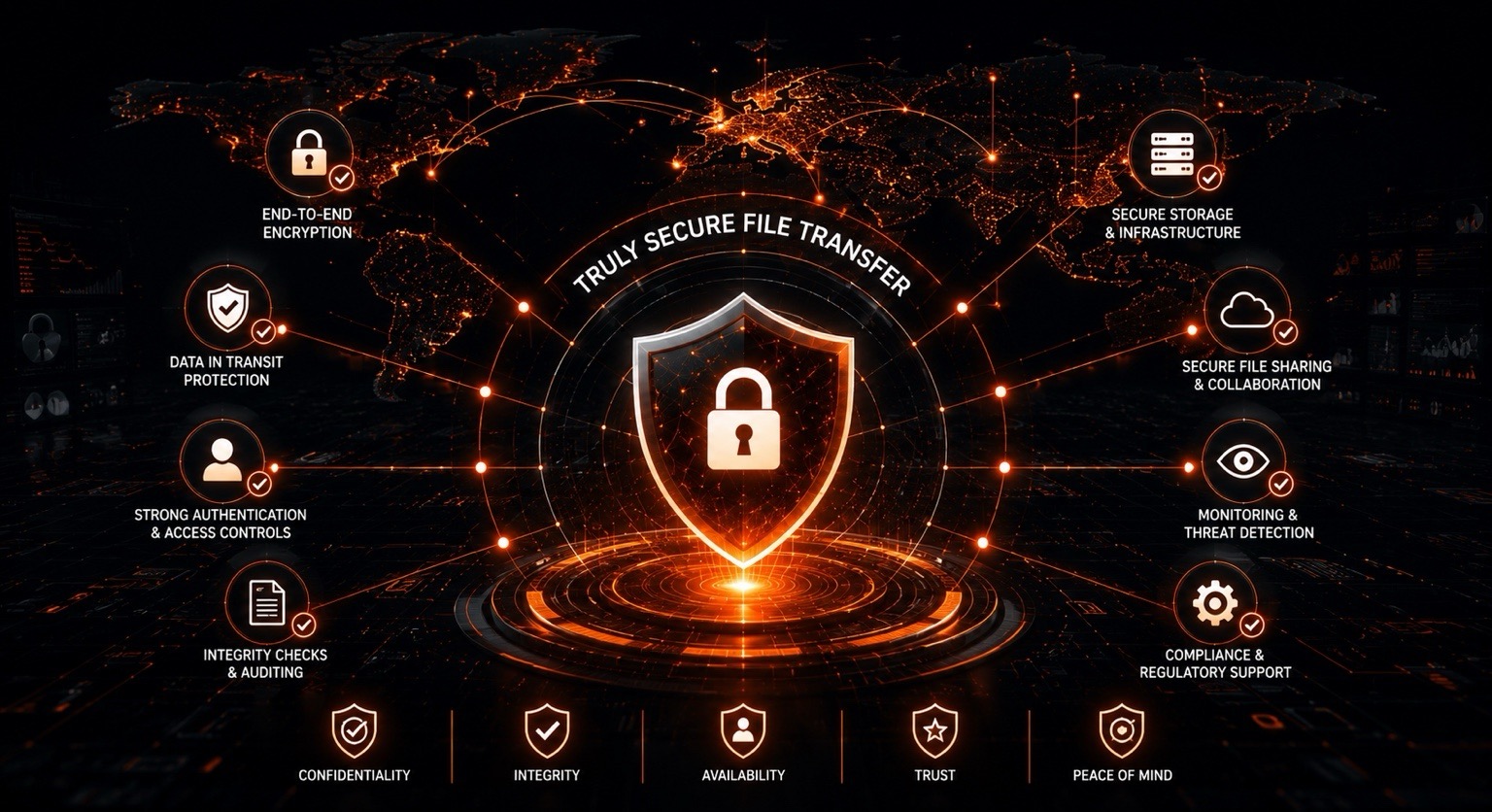
The conversation about how to move sensitive data between systems, partners, and storage environments used to be primarily technical. Which protocols: SFTP, FTPS, or legacy FTP? Which encryption standards? Which platforms? Today, that conversation has a legal and geopolitical dimension that cannot be separated from the technical one. Where your data goes, who can access it, and under which legal jurisdiction it sits are now material questions for any organization operating in regulated industries or across international borders.
This article examines the real differences between self-hosted and SaaS SFTP and managed file transfer deployments, not at the level of features and pricing, but at the level of control, legal exposure, and what data sovereignty actually means in practice. It also challenges a common assumption: that "SaaS" and "surrendering custody of your data" are the same thing. They are not, but most SaaS file transfer products treat them that way by default.
Data sovereignty is the principle that data is subject to the laws and governance of the jurisdiction where it is stored and processed. When an organization stores data on its own infrastructure, it controls that data absolutely. When it stores data with a third-party SaaS provider, that data becomes subject to the legal obligations of the provider, which may differ significantly from the organization's own obligations.
According to IDC's Future Enterprise Resiliency and Spending Survey from June 2025, 45% of all organizations and 56% of digital-native enterprises cited data sovereignty as their greatest concern for 2026. The complexity is not abstract. It is rooted in a specific and unresolved conflict between legal frameworks on different sides of the Atlantic.
The US CLOUD Act, enacted in 2018, permits US government agencies to demand electronic data from US-based service providers regardless of where that data is physically stored. A US-based file transfer SaaS provider storing your data in a European data center can still be compelled to produce that data under a US court order, without necessarily notifying you that the request was made.
In 2025, Microsoft publicly acknowledged that it cannot guarantee data sovereignty for EU customers, triggering significant concern among European security teams and compliance officers. Analysis by Proton of transparency reports from major US technology companies found that providers handed over information on 3.1 million accounts to the US federal government over a ten year period, a figure that excludes classified FISA requests entirely.
The conflict with European law is direct and structural. GDPR's Chapter V restricts transfers of personal data outside the EU without adequate protections. The EU Data Act, which began applying in September 2025, requires cloud providers operating in Europe to implement technical and organizational measures that prevent unlawful non-EU government access to data stored there. These two legal frameworks are not compatible, and no SaaS contract resolves that incompatibility. The organization using the service carries the compliance risk regardless of what the vendor's terms of service say.
The fundamental design of most SaaS file transfer platforms creates a specific and often underexamined risk: your files live on the vendor's infrastructure. That is not a configuration choice. It is the architecture. And it has consequences that extend well beyond the vendor's security posture.
When a SaaS file transfer provider is breached, every customer's data is potentially exposed simultaneously. This is precisely what happened with MOVEit. Organizations that had no direct relationship with the software found their data compromised because a vendor or partner they worked with was running MOVEit environments. According to research published by Cybersecurity Dive, PBI's exploited MOVEit environment ultimately compromised at least 354 additional downstream organizations. In a SaaS model where vendor infrastructure holds customer files, a single provider's security failure cascades across an entire customer base.
Vendor concentration creates additional risks that are frequently underweighted in procurement decisions. When a SaaS file transfer provider is acquired, merges with another company, or faces financial distress, the terms under which your data is stored and processed including through SFTP and FTPS file transfer infrastructure can change. Analysis of third-party risk notes that vendor financial distress can force emergency transitions with as little as 60 days notice, disrupting contracted services and leaving organizations without technical support for critical infrastructure. A perpetual license on self-hosted software cannot be revoked by a vendor's corporate decision.
The attack surface problem is equally concrete. Any SaaS file transfer platform that holds your files must, by definition, maintain an inbound path to the storage where those files live. That inbound path, whether a listening port, a NAT rule, or a DMZ endpoint, is an attack surface you do not control. You have outsourced your file transfer and inherited two attack surfaces: the vendor's storage, and your own network exposure required to connect to it.
Self-hosted SFTP server software eliminates the third-party data access problem at the architectural level. When your SFTP server runs in your own environment, whether on premises, in a private cloud, or in your chosen infrastructure, your data does not pass through anyone else's systems. There are no sub-processors to evaluate. There is no vendor transparency report to check. There is no CLOUD Act exposure through a US-based provider. The data is yours, and the controls that govern it are yours.
On-premises MFT solutions still account for approximately 48% of enterprise MFT implementations in 2024, according to Mordor Intelligence research, reflecting the reality that neither deployment model is universally superior. The organizations that choose self-hosted deployment in regulated industries are not making a conservative or outdated choice. They are making a deliberate architectural decision to retain full control over data that their compliance obligations require them to control.
The regulatory frameworks most relevant to file transfer infrastructure make this point explicitly. HIPAA requires that covered entities maintain control over systems handling electronic protected health information. GDPR requires that data processors implement appropriate technical and organizational measures. DORA, which entered full enforcement in January 2025, requires financial institutions to maintain control over failover procedures, backup strategies, and incident response without depending on vendor support tickets. These requirements do not preclude SaaS deployment, but they impose obligations that are significantly harder to satisfy when the infrastructure is outside your direct control.
For organizations operating in air-gapped environments, including defense contractors, government agencies, critical infrastructure operators, and certain financial institutions, SaaS file transfer is not an option regardless of the vendor's security posture. Self-hosted SFTP server software deployed within a controlled network perimeter is the only architecture compatible with these requirements. The US government's FedRAMP authorization framework, FIPS 140-2 and 140-3 certification requirements, and sector-specific security mandates across defense, healthcare, and finance all reflect this reality.
The comparison between self-hosted and SaaS file transfer is frequently framed as a cost question. Forrester's 2024 Cloud Economics report found that cloud MFT solutions typically reach cost parity with on-premises implementations at the three to four year mark, depending on scale and complexity. For organizations with perpetual licensing, the long-term economics favor self-hosted deployment even more clearly, since subscription costs compound annually while a perpetual license is a fixed capital expenditure.
But the cost comparison misses the most important dimension of the decision. The question is not only which deployment is cheaper. It is which deployment is compatible with the organization's compliance obligations, legal exposure, and operational requirements. A cheaper deployment that creates regulatory exposure, vendor dependency, or uncontrolled data access is not cheaper when those risks materialize.
There is an assumption embedded in most discussions of SaaS file transfer that deserves scrutiny: that "managed infrastructure" necessarily means "your files live on someone else's servers." This assumption has been so universal for so long that it is rarely examined. It is also beginning to be challenged.
The more precise question is not "self-hosted or SaaS?" It is "who holds custody of the files?" A managed, cloud-delivered protocol layer that terminates connections and routes encrypted traffic is fundamentally different from a cloud platform that stores your files. The first model can give organizations the operational simplicity of SaaS, including managed availability, automatic updates, and no infrastructure to operate, while keeping files entirely within the organization's own environment. The attack surface of such an architecture is a stateless relay. There are no files to steal and no standing inbound path to pivot through.
This model, sometimes described as a zero-custody architecture, inverts the data plane: the cloud handles the protocol edge, while a lightweight connector deployed on the organization's own storage initiates an outbound connection to the cloud layer. Nothing inbound is required. No firewall rules. No NAT. No DMZ exposure. The files never leave the organization's subnet. Data residency is trivially answered, because the answer never changed.
This is not the architecture of most SaaS file transfer products today. But it is the architecture that resolves the data sovereignty problem without requiring organizations to operate their own protocol infrastructure. It is also the direction the market will inevitably move as data sovereignty requirements become more stringent and the consequences of traditional SaaS custody models become more visible.
Data sovereignty is not a compliance checkbox. It is an architectural property of your infrastructure.
A SaaS SFTP and managed file transfer provider can offer strong security, competitive pricing, and extensive compliance certifications. None of those things change the fundamental reality that in most implementations, your data is passing through infrastructure you do not control, under terms that can change, subject to legal obligations that may conflict with your own, and vulnerable to breaches that affect every customer simultaneously.
For organizations in regulated industries, high-value commercial environments, or jurisdictions where data residency requirements are actively enforced, the relevant questions when evaluating any file transfer solution are straightforward:
Do my files leave my infrastructure? If yes, understand exactly where they go, under which jurisdiction, and who can access them under what legal authority.
What is my exposure if the vendor is breached? If your files are on their servers, the answer is: the same as every other customer.
What happens to my operations if this vendor changes its terms, raises prices, or ceases operations? Self-hosted software with perpetual licensing removes this variable entirely.
Can I produce tamper-proof audit evidence of every file access? Self-hosted deployments with cryptographically signed logs provide forensic records entirely within your control.
The organization that retains control over its SFTP, FTPS, and HTTPS file transfer infrastructure retains control over who can access its data, under which conditions, subject to which laws, and for how long. In an environment where those questions have moved from theoretical to regulatory, that control is not optional. And the architecture that delivers it does not have to mean operating your own servers.