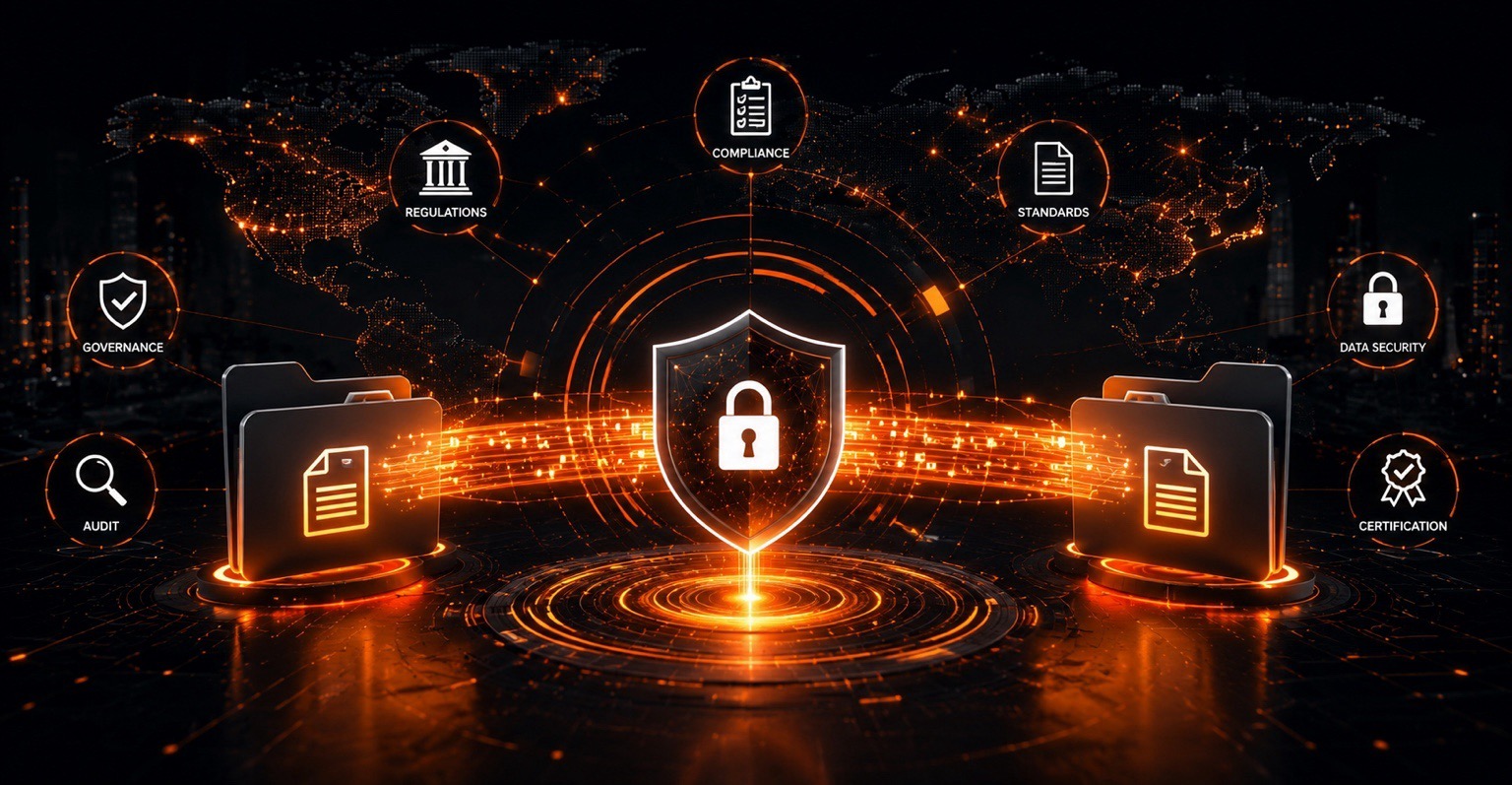
Organizations operating in regulated industries spend considerable effort producing compliance documentation, security policies, data handling procedures, and attestations to be signed and filed. What those documents describe and what the actual file transfer infrastructure does are not always the same thing. That gap is where most regulatory penalties originate.
Treating secure file transfer as a best practice rather than a compliance requirement is a common position. It is also an incorrect one, and the enforcement record makes that increasingly difficult to argue.
GDPR fines have exceeded 7.1 billion euros in cumulative total since the regulation came into force. More than 2,800 fines have been issued. In 2025 alone, approximately 1.2 billion euros in penalties landed across organizations in finance, healthcare, telecommunications, and the public sector. European data protection authorities are currently receiving 443 breach notifications per day, a 22% year-over-year increase. The enforcement map is widening. Finance, healthcare, and public sector organizations are firmly in scope, not just large technology firms.
HIPAA enforcement follows the same pattern. Penalties reach up to 1.5 million dollars per year per violation category. In January 2025, Solara Medical Supplies was fined 3 million dollars for multiple violations of the HIPAA Security and Breach Notification Rules following a phishing attack that compromised the protected health information of over 114,000 patients. The healthcare industry averages 9.77 million dollars per data breach, the highest of any sector, according to IBM's Cost of a Data Breach Report 2024. That figure does not reflect dramatic, sophisticated attacks against hardened systems. It reflects organizations that moved protected health information through channels that were not built to carry it securely.
The fine rarely comes because an organization tried hard and failed. It comes because the right controls were not in place to begin with.
Regulatory frameworks like HIPAA and GDPR do not specify which file transfer software an organization must use. They specify outcomes. Data must be protected in transit. Data must be protected at rest. Access must be controlled, authenticated, and audited. Breaches must be detectable and reportable within defined timeframes. The technical implementation is left to the organization.
The problem is that this flexibility gets interpreted as room to improvise. Consumer file sharing apps. Email attachments. Legacy FTP servers. These are not compliant implementations. They are organizations hoping that nobody asks too many questions about how exactly the data got from one place to another.
HIPAA requires that electronic protected health information be encrypted during transmission. It requires audit controls that record activity in systems containing ePHI. It requires that access to that information be limited to authorized users, with controls to verify that limitation is actually enforced. GDPR requires that personal data be processed with appropriate technical and organizational measures, proportionate to the risk. The EU Cyber Resilience Act is extending security-by-design requirements further, to connected products at the design level.
None of these requirements are satisfied by an FTP server with a shared password, a Dropbox folder with open link sharing, or an email attachment with no encryption. But all three of those are in active use, right now, in organizations that have signed compliance attestations saying their data handling meets regulatory standards.
This is the part nobody talks about at conferences. The compliance documentation says one thing. The actual file transfer infrastructure says another. Someone in operations needed to get a large file to a vendor quickly, and the approved secure channel was cumbersome, so they used something else. That workaround became a habit. The habit became a process. The process got documented nowhere. And now there is a data flow that exists entirely outside the governance framework the organization thinks it has.
This is not negligence in the dramatic sense. It is what happens when security infrastructure is hard to use. The easiest path wins. If the easiest path is also the insecure one, the insecure one gets used. The compliance framework exists on paper. The actual data takes a different route.
The solution is not more documentation or stricter policies. It is making the compliant path the easy path. A file transfer platform that enforces encryption automatically, requires authenticated access, logs every transaction, and does not offer an "I'll just send it quickly without all that" option is not a restriction on productivity. It is the only way to ensure that the behavior the compliance documentation describes is the behavior that actually happens.
The technical requirements are well understood and map directly to what the major regulatory frameworks demand.
Encryption in transit and at rest, using current protocol standards rather than legacy implementations with documented vulnerabilities. MFA on every account that touches sensitive data, not just administrator accounts. Granular access controls at the folder and user level, enforced at the protocol level rather than through policy documents. Comprehensive, tamper-resistant audit logs that capture who accessed what, when, from which IP, and what actions were taken. Automated detection and blocking of suspicious behavior, so the system does not depend on a human analyst being available at the moment an attack begins. High availability architecture that keeps operations running when individual components fail, because compliance requires not just protecting data but ensuring systems remain operational and that disruptions are detectable and recoverable. The most defensible HA implementations go further than passive failover. Automatic node recovery, cryptographic inter-node authentication, and continuous heartbeat monitoring independent of data replication are the markers of an HA architecture built for environments where downtime has regulatory consequences, not just operational ones.
These are not features that go above and beyond what regulations require. They are the minimum technical translation of what HIPAA, GDPR, and government security mandates actually specify.
Comprehensive audit logging is mandatory across HIPAA, GDPR, and government security mandates. But not all logs are created equal, and the difference matters significantly in a compliance or forensic context.
A standard audit log, even a detailed one, is vulnerable to tampering. An attacker who gains administrative access can alter or delete log entries to cover their tracks, undermining the entire purpose of the audit trail. Compliance frameworks assume logs are evidence. Logs that can be retroactively modified are not reliable evidence at all.
Cryptographically signed audit logs solve this problem. Each log entry is digitally signed and linked to the previous entry, creating an immutable chain. If an attacker attempts to alter any entry, the signature breaks and the tampering becomes immediately detectable. In a compliance investigation or incident response scenario, tamper-proof logs are the difference between reconstructing exactly what happened and working from an incomplete or unreliable narrative.
Organizations in regulated industries should verify that their file transfer infrastructure implements cryptographically signed logs, not just logging. It is the difference between audit trails that satisfy compliance requirements on paper and audit trails that can be forensically defended in practice. When evaluating file transfer platforms, organizations in regulated industries should ask specifically whether logs are cryptographically signed, not just generated. The answer to that question separates tools built for compliance environments from tools that were adapted for them after the fact.
The organizations that treat compliance as optional are not saving money. They are deferring a cost that keeps getting larger. Regulatory frameworks are expanding, not contracting. Enforcement is intensifying, not easing. And the total cost of a breach in a regulated industry, combining the fine, the remediation, the legal exposure, the reputational damage, and the operational disruption, reliably exceeds the cost of the infrastructure that would have prevented it.
The question of whether proper secure file transfer infrastructure is "worth it" is the wrong question. The right question is what it costs to not have it. In most regulated environments, that cost is now a matter of public record.
The only remaining variable is how long it takes to arrive at that conclusion.