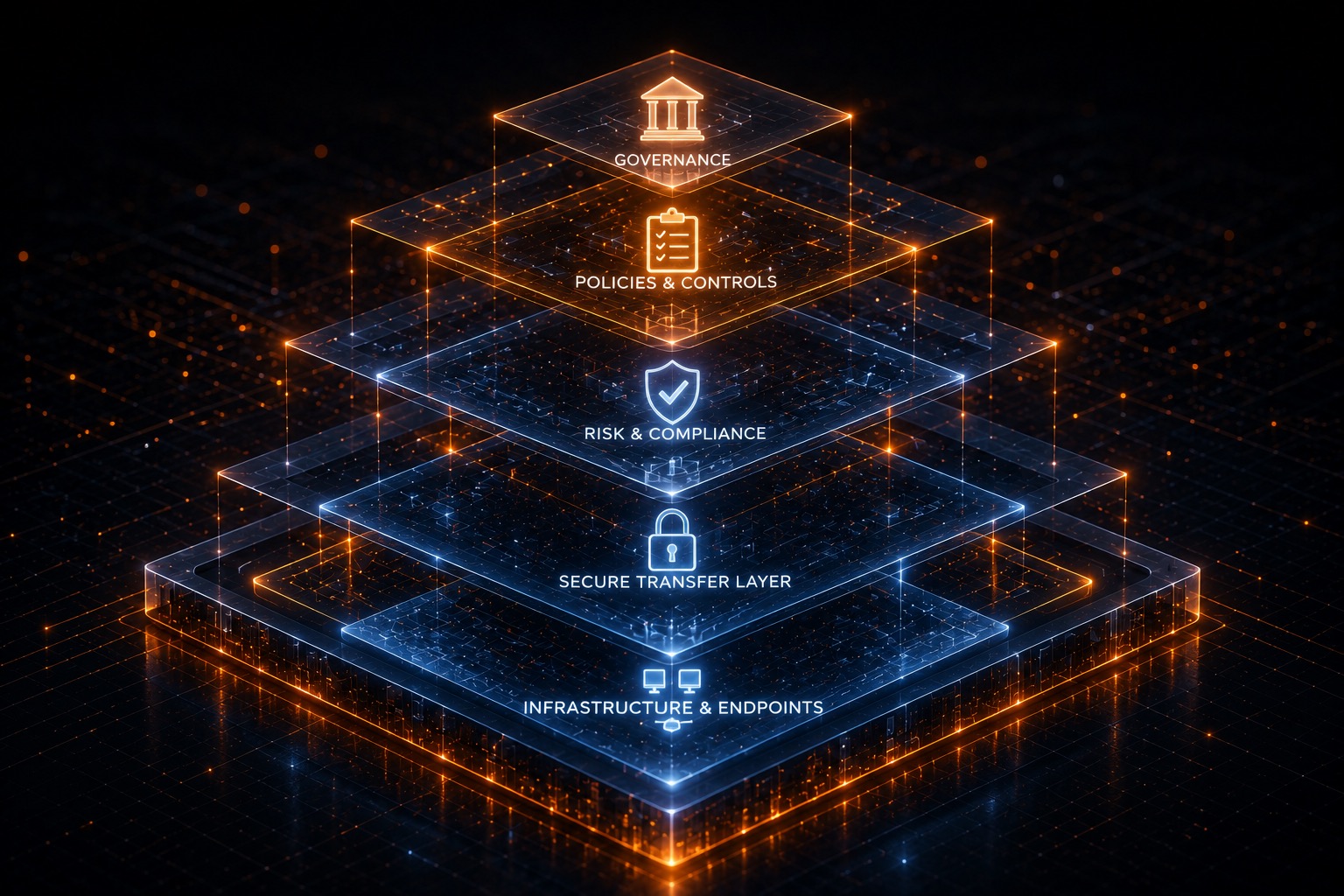
Organizations today operate in an environment where sensitive data moves constantly between teams, systems, partners, cloud platforms, and storage backends. Protecting that data is no longer a matter of installing a firewall and calling it done. It requires a layered, deliberately architected approach to information security, applied consistently across every system that touches sensitive data.
Here is what that actually looks like in practice.
The principle of least privilege is the foundation of serious information protection. Every user, every service account, and every third-party integration should have access to exactly what their role requires, and nothing beyond that.
In practice, this means access controls set at the folder level, not broad departmental permissions. It means time-based restrictions, IP whitelisting, separation of control and data planes, and (when possible) inverted data planesand speed limits on data transfers. It means reviewing access permissions regularly and revoking them the moment they are no longer needed. Overly broad permissions are not a minor inefficiency. They are a standing invitation to attackers who compromise an account, to insiders who overstep, and to auditors who will ask exactly why that contractor had read access to finance records six months after their engagement ended.
A purpose-built secure file transfer service enforces these controls at the protocol level, not just through policy documents that employees may or may not follow.
Data in motion is vulnerable. So is data at rest. Both need to be encrypted, and the protocols, algorithms, and methods used to encrypt them matter.
Legacy FTP transmits data including credentials in cleartext. Anyone with access to the network path can read it. SFTP and FTPS use modern encryption to protect data in transit. That is the baseline. Beyond that, data stored on servers needs to be encrypted at rest, so that physical access to storage does not automatically mean access to its contents.
Encryption is not glamorous, but its absence is one of the most common and most avoidable causes of data exposure.
Passwords are compromised constantly through phishing, credential stuffing, reuse across personal and corporate accounts, and data from third-party breaches. A username and password alone is not a reliable authentication mechanism anymore.
Multi-factor authentication (MFA) adds a second layer that stolen credentials cannot bypass on their own. It is one of the highest-return controls available, and it needs to be applied consistently, not just to administrator accounts, but to every user who has access to sensitive data. Carve-outs and exceptions for convenience erode the protection entirely.
Reactive security, discovering a breach after it has already occurred, is not a viable strategy. By the time a traditional investigation identifies an intrusion, the damage is usually done.
Modern information protection requires active, real-time threat detection: automated blocking of IP addresses exhibiting suspicious behavior, geo-blocking, detection of brute-force login attempts, and the ability to penalize persistent attackers rather than simply blocking a single attempt and resetting. The best platforms combine rule-based heuristics with AI to catch unknown threats alongside known ones, without requiring a human analyst to be watching a dashboard at the exact moment an attack begins.
Knowing what happened, and being able to prove it, is as important as preventing incidents in the first place. In regulated industries, this is a compliance requirement. In any industry, it is what makes incident response possible.
Audit logs need to be comprehensive, tamper-resistant, and queryable. Who accessed which files, when, from which IP address, and what actions did they take. A flat log file that nobody can efficiently search is not useful when you are trying to reconstruct a breach at two in the morning. The logging infrastructure should be treated as a core security component, not an afterthought.
Information security is not only about keeping unauthorized users out. It is also about keeping authorized users in, meaning operations need to stay running even when individual components fail.
A single-node deployment is a single point of failure. Enterprise information protection requires fault-tolerant, clustered architecture where the failure of one node does not bring down the entire system or create gaps that attackers can exploit. High availability is a security property, not just an operational one.
Not every system needs access to every other system. Network segmentation limits the blast radius of any single compromise. If an attacker gains a foothold in one part of the environment, segmentation prevents them from moving laterally into everything else.
In file transfer environments specifically, multi-site isolation allows different teams, external partners, and distinct workflows to operate in separate, independently administered instances. A breach in one segment does not automatically expose the rest. This architecture also simplifies compliance, since data flows can be isolated and audited independently.
A particularly strong implementation of network isolation goes one step further by inverting the data plane entirely. In a conventional architecture, the SFTP server initiates contact with backend storage, which means the storage subnet must accept inbound connections and is therefore reachable from the network perimeter. An inverted architecture reverses this: the storage connector, sitting in a fully isolated subnet with no inbound firewall rules whatsoever, initiates an outbound connection to the SFTP endpoint in the DMZ. Once that connection is established, the two sides invert their roles over a reverse tunnel, and file transfer proceeds normally.
From the storage subnet's perspective, there is simply nothing to attack: no open port, no listening service, no reachable surface. Even a fully compromised DMZ node cannot pivot into storage, because the storage side never accepts a connection from anyone. This is not a compensating control layered on top of conventional architecture; it is a fundamentally different trust model, and it renders an entire class of lateral movement attacks structurally impossible rather than merely difficult.
Every technique described above exists because of a single underlying reality: the most reliable entry point into any organization's systems is not a technical vulnerability. It is a person.
According to Verizon's 2025 Data Breach Investigations Report, the human element is present in roughly 60% of all breaches. Credential abuse remains the single most common initial access vector, and third-party involvement in breaches doubled year over year from 15% to 30%. Research across multiple cybersecurity sources shows the median time between a phishing email arriving and an employee clicking it is just 21 seconds, 98% of cyberattacks involve some form of social engineering, AI now generates over 82% of phishing emails, and vishing attacks surged 442% in the second half of 2024.
This is why technical controls cannot be designed as though human behavior will always be correct. Access controls that assume compromise. MFA that removes the value of stolen credentials. Automated blocking that does not depend on a human catching an anomaly in time. Audit logs that reconstruct what happened even when nobody was watching.
These are not redundant with good security awareness training. They are what makes the overall system resilient when training alone is not enough, which is most of the time.
Attackers have understood for years that the human is the most efficient entry point. Information protection that does not account for this is solving the wrong problem.
Syncplify Server! is built around exactly these principles, with granular access controls, SFTP and FTPS encryption, AI-powered intrusion prevention, tamper-proof audit logs, and enterprise-grade high availability. If you are evaluating secure file transfer solutions, you can try it free for 15 days.