Most conversations about cybersecurity focus on financially motivated attacks. Ransomware groups encrypting hospital systems until a payment clears. Credential theft operations selling access to corporate networks. Fraud, extortion, data brokerage. The overwhelming majority of cyberattacks fall into this category, and the defensive playbook for dealing with them is reasonably well understood: reduce the attack surface, harden authentication, monitor for anomalies, back up data, and have a response plan.
Cyberterrorism operates by a different logic entirely. Understanding that difference is not an academic exercise. It changes who the targets are, what the attackers are trying to achieve, and what adequate protection actually looks like.
The FBI defines cyberterrorism as a premeditated, politically motivated attack against information systems, computer programs, and data, carried out by subnational groups or clandestine agents (non-state actors operating outside official military command) with the intent to cause harm to noncombatant targets. NATO's definition focuses on attacks designed to generate fear or intimidate a society toward an ideological goal. The common thread across definitions is motivation: political, ideological, or social goals, not financial ones.
This distinction matters more than it might appear. A financially motivated attacker wants to extract value and move on. Disruption is a means to an end. A cyberterrorist may want the disruption itself. The goal is not ransom payment. It is fear, instability, loss of public confidence in institutions, or the demonstration of a capability that signals something to a government or population. An attack that shuts down a power grid for six hours has accomplished its purpose even if no money changes hands and no data is stolen. Ukraine experienced exactly this in 2015 and 2016, when Russian-attributed attacks using BlackEnergy and Industroyer malware cut power to over 230,000 people across western Ukraine in 2015 and briefly blacked out a portion of Kyiv in 2016, not to extract payment, but to demonstrate reach and cause suffering. That is a fundamentally different threat model.
The line between state-sponsored cyber espionage, hacktivism, and cyberterrorism is not always clean, and attribution is genuinely difficult. But the pattern of politically motivated attacks has become impossible to ignore.
Russian cyberattacks on Ukraine surged by nearly 70% in 2024, with 4,315 incidents recorded by Ukraine's CERT-UA targeting critical infrastructure including energy, communications, and government systems. It is worth noting that while attack volume rose sharply, Ukraine's defenses appear to be improving in parallel. The number of truly critical-severity incidents actually declined significantly over the same period, reflecting the ongoing adaptation happening on both sides of an active cyber conflict. The objective was not financial. It was operational disruption in support of a military and political campaign.
Chinese cyber espionage operations rose by 150% overall in 2024, with attacks on specific critical sectors in finance, media, and manufacturing climbing as high as 300%, according to CrowdStrike's 2025 Global Threat Report. Notably, analysts assess that many of these intrusions are not aimed at immediate disruption. Instead, they appear designed to establish long-term footholds in critical infrastructure across energy, telecommunications, and water that could be activated during a future geopolitical crisis. That is a different and in some ways more troubling threat than attacks aimed at causing immediate damage.
In November 2025, the Russian-aligned group NoName057(16) claimed responsibility for DDoS attacks against Belgian telecom operators, a university hospital, and the country's military intelligence service. The trigger was explicit: a Belgian cabinet minister had stated in a magazine interview that NATO would respond with overwhelming force if Russia attacked a member state capital. The group's Telegram post cited the interview directly and advised the minister "not to make such statements." The attacks were framed from the start as political retaliation, not financial opportunism.
Since 2022, hacktivist groups have escalated beyond the distributed denial-of-service attacks and document leaks that defined earlier operations, moving into attacks on operational technology and critical national infrastructure. The shift is significant. Disrupting a website is a statement. In April 2025, a Norwegian hydropower dam was hacked, opening a floodgate and releasing 500 liters of water per second for four hours, in an incident officials attributed to pro-Russian actors and described as deliberate sabotage. Disrupting industrial control systems or water treatment infrastructure is something closer to an act of war.
Nearly 60% of organizations report that shifting geopolitical dynamics have directly influenced their cybersecurity strategies, according to the World Economic Forum's Global Cybersecurity Outlook 2025. That figure reflects a growing recognition that the threat environment is no longer just commercial. It is political.
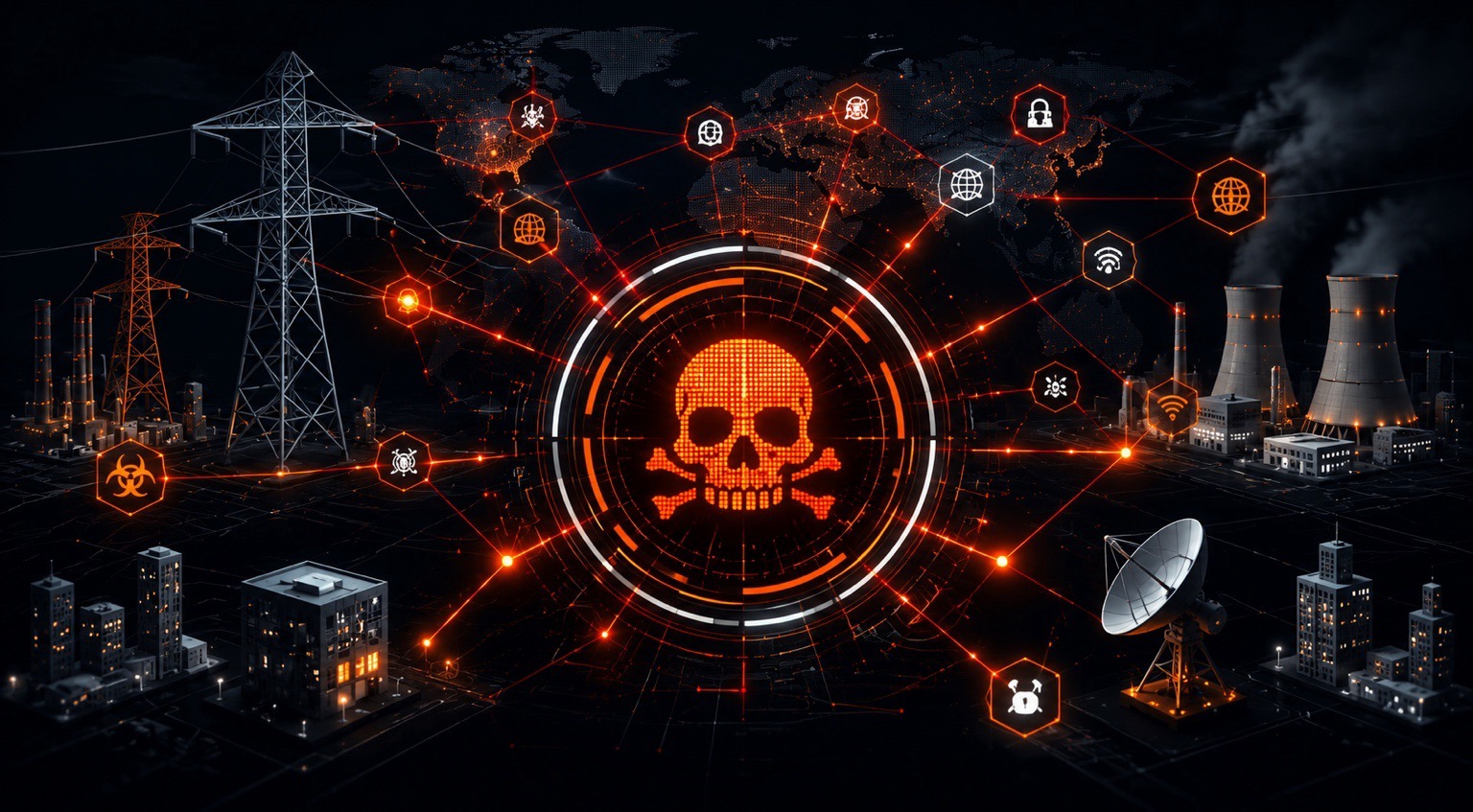
Cyberterrorism and state-sponsored attacks do not pursue the same targets as financially motivated criminals. The high-value targets are institutions and infrastructure whose disruption causes the most visible fear or the most significant operational damage: energy grids, water systems, financial networks, government agencies, healthcare systems, defense contractors, and telecommunications providers.
Organizations in these sectors, and the vendors and partners who serve them, are not incidental targets. They are the point. A hospital ransomware attack might be opportunistic. An attack on a hospital network during a period of heightened geopolitical tension, by a group with documented ties to a state actor, is not the same category of event even if the technical mechanism looks identical.
This is why organizations in regulated and government-adjacent industries cannot treat their security posture as a purely commercial calculation. The question is not only "how do we protect ourselves against criminals seeking financial gain?" It is "how do we protect ourselves against adversaries for whom disruption is the goal, and for whom the normal deterrents like prosecution risk, reputational damage, and loss of future revenue do not apply?"
One vulnerability that receives less attention than it deserves is the file transfer infrastructure that critical sectors depend on every day. Water treatment facilities, power grids, financial networks, and government agencies all rely on secure file transfer for operational data, control system updates, and inter-agency communication. A breach in that infrastructure through weak authentication, unencrypted data, or insufficient access controls creates a vector for political actors to inject malicious commands, exfiltrate sensitive operational data, or disrupt critical workflows.
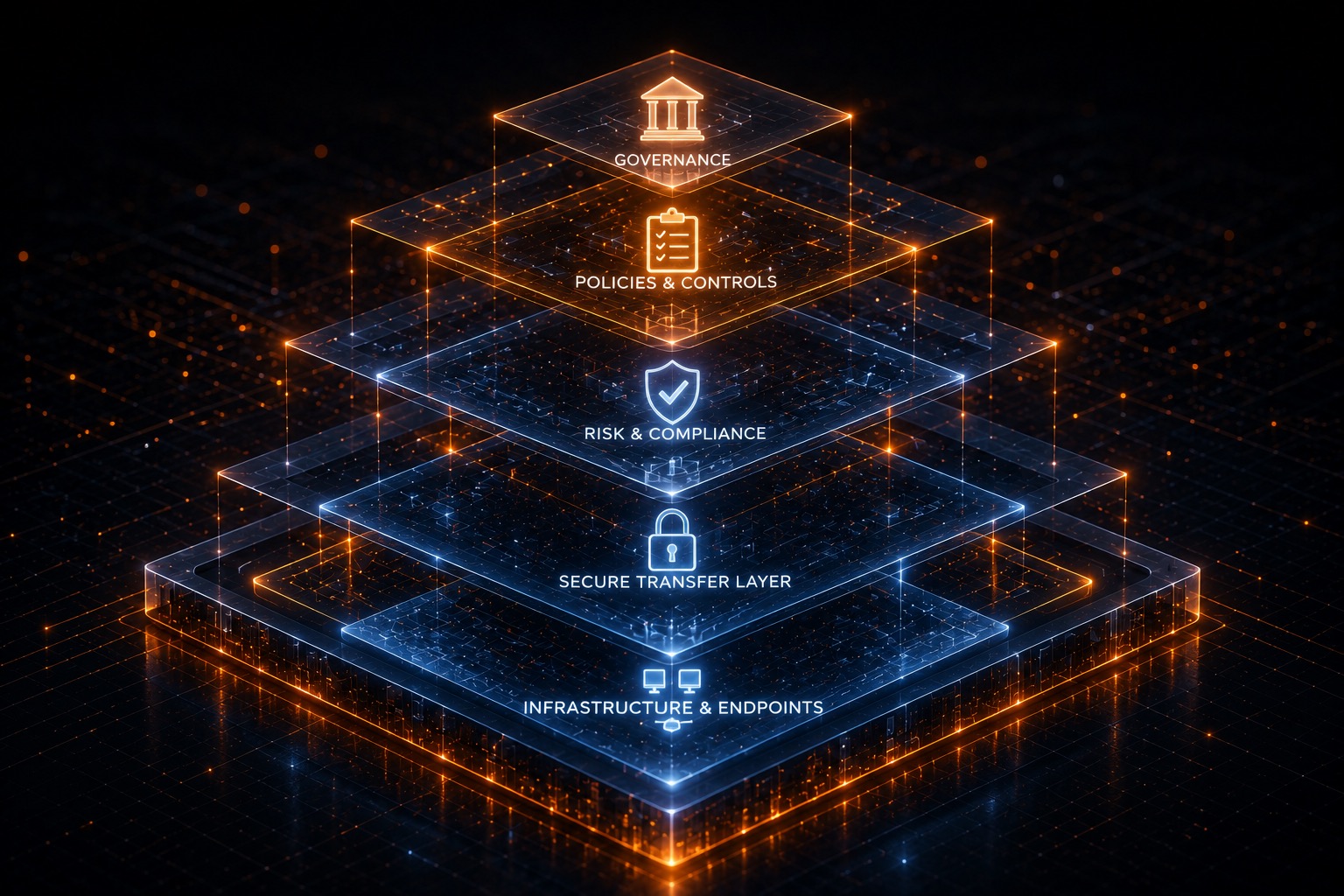
For organizations in critical sectors, file transfer infrastructure must be hardened to the same standard as the operational systems it serves. That means encryption at rest and in transit, mandatory multi-factor authentication without exceptions, granular access controls at the folder level rather than just the account level, real-time monitoring that flags unusual access patterns before they become incidents, and audit trails designed to survive an attack so forensic reconstruction is possible afterward. High availability architecture ensures that file transfer remains operational even if attackers compromise one component, because in a politically motivated attack, keeping services degraded may itself be the objective.
Organizations that treat file transfer as a secondary concern, running legacy protocols, consumer file-sharing tools, or systems built before the threat model shifted toward nation-state actors, are creating a meaningful gap in their defensive perimeter, and sophisticated adversaries are well aware of it.
The defensive response to cyberterrorism shares a technical foundation with the response to conventional cybercrime. Strong authentication. Encrypted data in transit and at rest. Granular access controls. Real-time threat detection. Comprehensive audit trails. High availability architecture. These controls matter regardless of whether the attacker is motivated by money or ideology.
Where the response diverges is in the threat model assumptions. Financially motivated attackers are generally looking for the easiest path to a payable outcome. They move on when the target is hardened enough to make the effort unprofitable. Politically motivated attackers may be better resourced, more persistent, willing to absorb costs, and focused on targets that cannot simply opt out by being too difficult. Critical infrastructure does not decline to be critical.
For organizations in high-value sectors, this also means establishing connections with government threat intelligence channels that financially motivated attack scenarios rarely require. CISA sector alerts, information sharing through sector-specific ISACs, and coordination with national cyber agencies provide early warning about state-sponsored campaigns that no private organization can generate on its own. The intelligence gap between knowing you were attacked and understanding who did it and why is where politically motivated attacks are most dangerous, and where external intelligence relationships matter most.
Security cannot be calibrated purely against the average attacker. It needs to account for adversaries with nation-state resources, long time horizons, and goals that have nothing to do with a ransom payment. That is a harder problem. It also has solutions: defense in depth, network segmentation, zero-trust architecture, active monitoring that can detect anomalous behavior rather than just known attack signatures, and a clear-eyed view of which assets in your environment an adversary would consider worth the effort.
The threat is real, it is growing, and it is qualitatively different from the cybercrime that dominates most security headlines. Organizations that understand that difference are in a better position to respond to it. Organizations that treat all cyberattacks as variations on the same financially motivated template are leaving a significant gap in their defensive posture, and the adversaries who exploit politically motivated attacks are well aware of it.